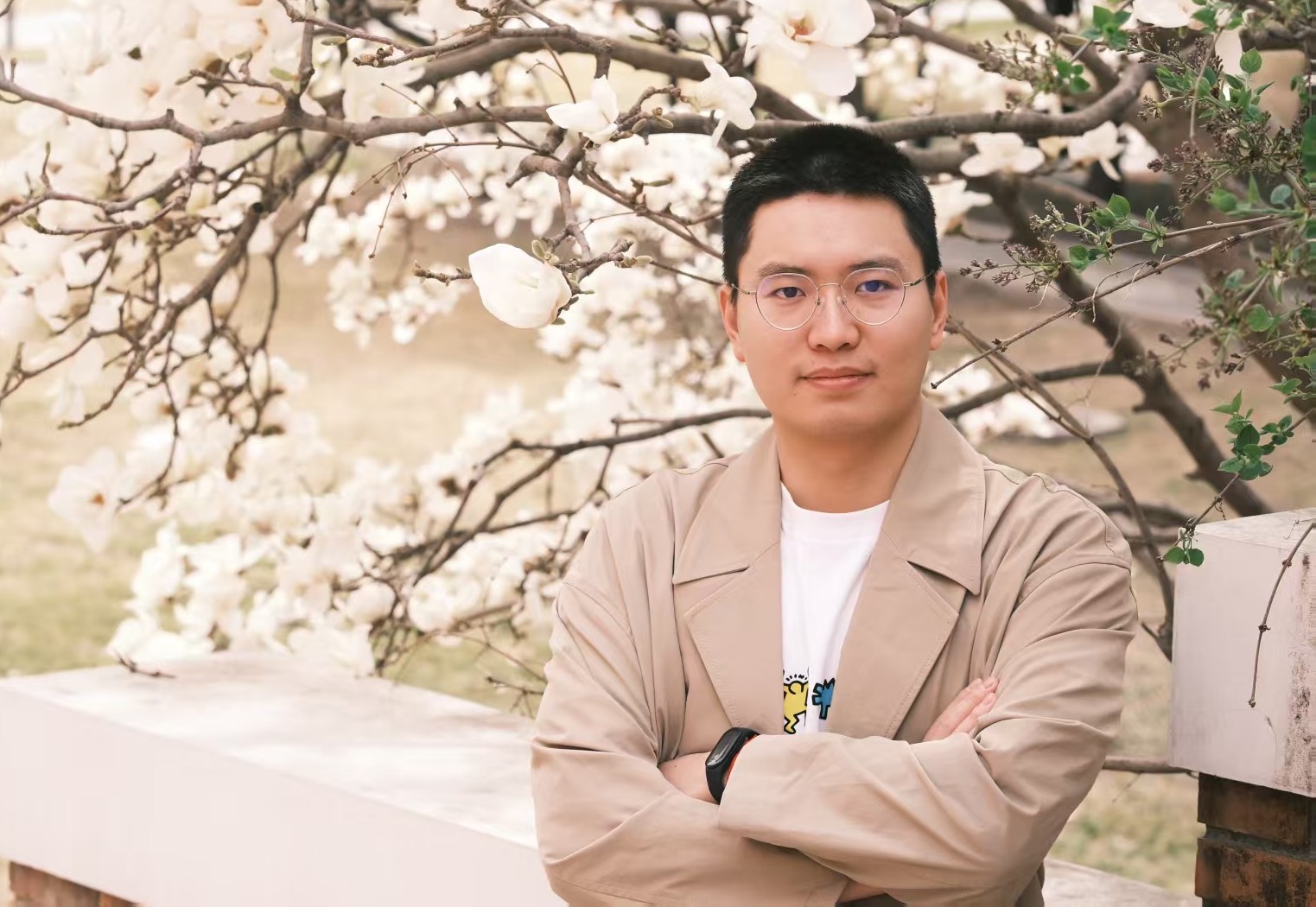
About me
👋 Hi, I’m Ziti Liu — a Ph.D. student (combined Master-Ph.D. program, currently in my 4th year) in Computer Science and Technology at the School of Advanced Interdisciplinary Sciences, University of Chinese Academy of Sciences, co-advised by the Institute of Automation, the Institute of Mechanics and TsingHua University. My research focuses on AI for Science, including both traditional Physics-Informed Neural Networks (PINNs) and the application of Large Language Models (LLMs) in neural network architecture design for scientific problems, especially for PDE solving.
🎓 Education
- (2022.9 – 2027.6) Ph.D. in Computer Science and Technology, University of Chinese Academy of Sciences, Research direction: AI for Science
- (2018.9 – 2022.6) B.Eng. in Aircraft Design and Engineering, Huazhong University of Science and Technology , Outstanding Graduate
🛠 Skills & Interests
- Programming: Python, C++, MATLAB
- Machine Learning: PyTorch, PINNs, llama, AI for PDEs, scientific computing
- Languages: English (IELTS 7.0), Mandarin (Native)
- Others: LaTeX, numerical analysis, data structures, algorithms
- Hobbies: Fitness, swimming, basketball, piano, photography
🧑💻 Projects
Generative Physics Engine Scenario Agent (Ongoing)
- Project: Integrates generative language models to address accuracy issues in physical data inversion with traditional large models.
- Work: Developed a physics-agent framework based on LLM-SR, significantly reducing the time required by traditional symbolic regression methods. Embedded a reasoning evaluator to enhance LLM’s answer filtering and correct reasoning abilities, improving inference accuracy and stability in physical scenarios.
Structured Physics-Informed Neural Networks via Knowledge Distillation
- Project: Utilized knowledge distillation algorithms to embed physical features into neural network structures, addressing interpretability and applicability challenges.
- Work & Results: Built a PyTorch-based experimental platform, overcoming manual model construction and strong prior dependency. Developed the gray-box model ψ-NN with higher accuracy, stability, and interpretability (algorithm performance improved by ~90%), reducing computational resource consumption to 7% of the original, suitable for low-power sensor group algorithms.
Adaptive Symmetry-Recomposition Physics-Informed Neural Networks
- Project: Leveraged Lie symmetry properties of PDEs to enhance neural network robustness and accuracy under sparse sampling.
- Work & Results: Established a PyTorch-based platform, demonstrating high efficiency and accuracy in handling symmetric PDEs and ill-posed sampling. Enhanced PINNs for sparse sensor arrays (sampling density reduced by 50%) and high-precision computation on low-power devices (accuracy improved by 90%).
📚 Publications
- Automatic Network Structure Discovery of Physics Informed Neural Networks via Knowledge Distillation, Nature communications, 2025 (JCR Q1 TOP, IF 15.7)
- AsPINN: Adaptive Symmetry-Recomposition Physics-Informed Neural Networks, Computer Methods in Applied Mechanics and Engineering, 2024 (JCR Q1 TOP, IF 7.5)
- Robust Fault-Tolerant Flushing Air Data Sensing Algorithm via Incorporating Physical Knowledge, IEEE T-AES, 2024 (JCR Q1 TOP, IF 5.7)
- Current Status and Prospects of Gas Turbine Technology Application, JPCS, 2021 (co-first author, EI)